
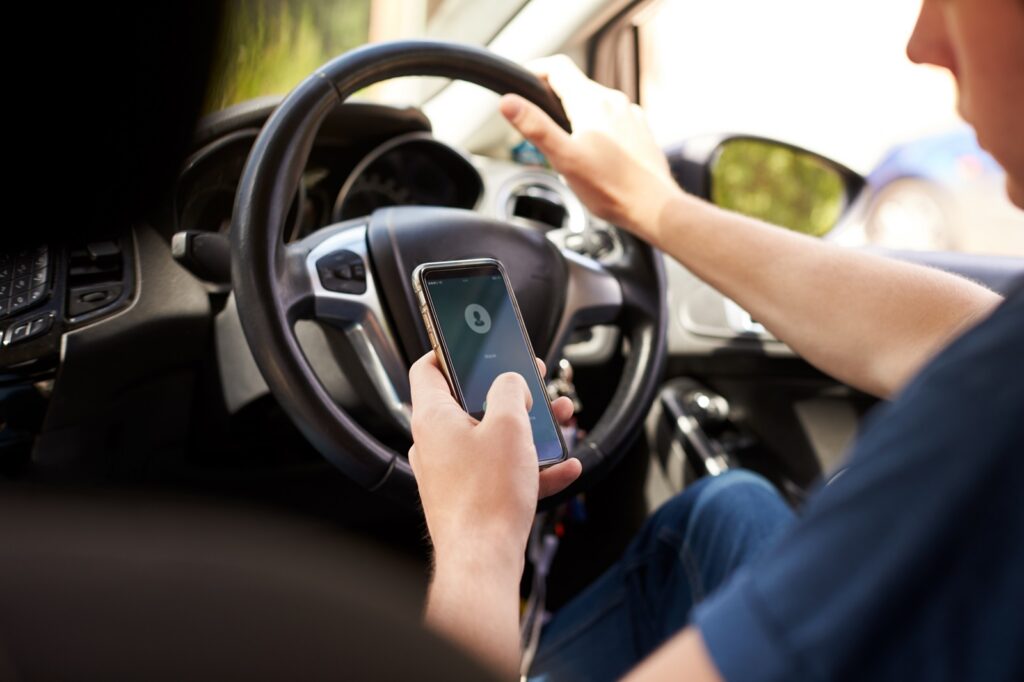

The use of mobile phones has become an essential part of everyday life in the UK, to the extent that many people struggle to carry out daily tasks without them. With the increasing reliance on mobile devices, it is no surprise that almost half (47%) of drivers aged 25–34 admit that they make or receive calls while driving, and many struggle to avoid interacting with their phones when behind the wheel. In fact, nine out of ten drivers struggle to complete a journey without being distracted by their device. Despite phone use being so common for road users, how dangerous is mobile phone use whilst driving?
The impact of mental distraction on driving ability
It may seem that a quick glance at a phone isn’t long enough to cause harm, but research shows that the real impairment is the mental distraction from the driving task. After using your phone, it can take up to 30 seconds to regain full attention, during which driving performance is significantly reduced. Distracted driving events can last as long as 200 seconds while the vehicle is in motion. At 30mph, this means a driver could travel almost 1.7 miles without full concentration; at motorway speeds, this increases to nearly 4 miles.
The mental distraction caused by phone use means that texting while driving is six times more likely to result in an accident than driving under the influence of alcohol. This risk is well recognised—an AA Trust poll found that 71% of respondents believed texting while driving is more likely to cause a crash than drink‑driving. Despite this awareness, only 10% of motorists manage to complete a journey without interacting with their phone.
The consequences of distracted driving
When a driver’s attention is impaired by a mobile phone, their ability to react to hazards is significantly reduced. The consequences often fall upon innocent road users and can be catastrophic. Official statistics show that “distraction or impairment” was the third most common cause of fatal crashes in 2023, contributing to 34.9% of deadly incidents. The Reported Road Casualties Great Britain 2022 report recorded that 22 people lost their lives and a further 674 were injured in a road traffic collision where mobile phone use was noted as a contributory factor.
Injuries sustained from road traffic accidents linked to distracted driving range from whiplash and broken bones to severe head and brain injuries, and in some cases, fatalities.
Understanding the law on mobile phone use while driving
It is illegal to hold and use a mobile phone or any handheld device capable of sending or receiving data while driving, even if the vehicle is stationary—including at traffic lights or in congestion. Exceptions apply only where a driver needs to call 999 or 112 in a genuine emergency and stopping is unsafe, or when using a handheld device to make a contactless payment while stationary.
Changes introduced in 2022 extended the ban to cover all handheld use, including texting, taking photos or using apps. Hands‑free use is permitted, but drivers can still be prosecuted if it causes distraction or results in a lack of proper control. The standard penalty for using a handheld mobile phone while driving is a £200 fine and six penalty points. New drivers who passed their test within the last two years will lose their licence.
Tips for safe placement of your phone when using a Sat Nav
• Adjust your seat and mirrors before setting up your phone.
• Mount your phone at the lower left or right of the windscreen to keep the road clear.
• Avoid high placement, as wires can interfere with driving.
• Do not place your phone above or in front of an airbag zone.
• Ensure the phone is securely fixed to avoid falls when driving over bumps.
• Enter your destination before beginning your journey to avoid handling the device.
Key aspects of mobile phone driving laws in 2026
• Total Ban on Holding Devices: Applies even if offline or in flight mode.
• When the Ban Applies: Covers all situations where the engine is running.
• Permitted Use: Hands‑free only via secure cradle/holder.
• Penalties: £200 fine, 6 penalty points, licence revoked for new drivers.
• Court Action: Fines up to £1,000 (£2,500 for lorry/bus drivers) and potential driving bans.
• Emergency Exceptions: Only for genuine emergencies when pulling over is unsafe.
• Payment Exceptions: Permitted when stationary, e.g., at drive‑throughs.
Police forces now use highly accurate mobile enforcement cameras to identify drivers using handheld phones, increasing the likelihood of detection.
How Enable Law can support you
If you have suffered serious injury as a result of a distracted driver, we may be able to help you claim compensation. It is important to seek legal advice as soon as possible, as the timeframe to bring a personal injury claim is three years. Legal support can help secure vital funding for treatment and rehabilitation.
At Enable Law, we specialise in supporting individuals who have suffered serious or catastrophic injuries. Our specialist personal injury team can help if you or a loved one has been injured due to someone else’s negligence. Our aim is to secure the best possible support for you, enabling you to live as full and independent a life as possible, with the necessary funding in place for long‑term needs.
To speak with a member of our team, call us on 0800 044 8488 or fill in our contact form so we can arrange to call you at a time convenient to you.