
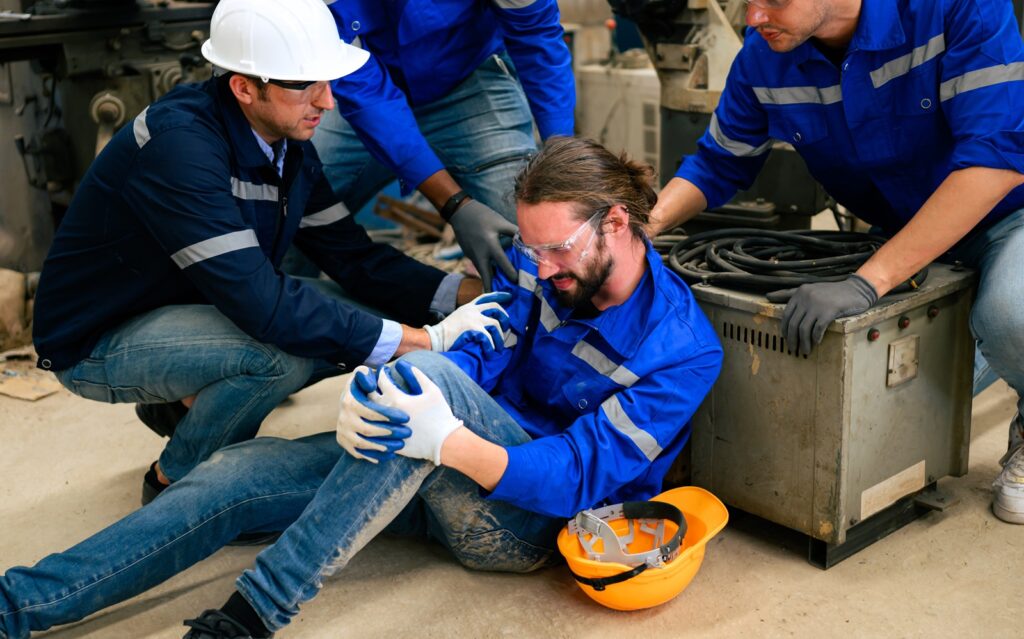

A recent Health and Safety Executive (HSE) report highlighted the case of an employer fined £140,000 after a Ukrainian worker lost part of his finger while cutting pigs’ tails. The HSE found several failings, including the fact that training was provided only in English, despite the company employing a large number of migrant workers. This meant key safety information was not effectively communicated, placing already vulnerable workers at significant risk.
Employers are legally required to provide information, instruction, training and supervision in a format that can be understood by every worker. When this does not happen, the quality of training is compromised and the risk of serious – and sometimes fatal – accidents increases.
Industries with higher risks for foreign workers
Foreign workers commonly find employment in sectors such as agriculture, food processing, construction, healthcare, manufacturing, hospitality, cleaning and waste management. These are industries where heavy machinery is used and tasks often involve repetitive, physically demanding work. As a result, the likelihood of workplace injuries is already higher than average, and that risk increases further for workers who may not fully understand the safety measures in place.
Why foreign workers may be more vulnerable
Many foreign workers arrive in the UK with limited familiarity with the British health and safety system. Standards in their home countries may be lower, and risk-taking may be seen as a normal part of employment. When they start work in Great Britain – sometimes after only a short time in the country – they may be unaware of their rights, unfamiliar with how to raise concerns, and unclear about the protections they are entitled to.
Language is a significant barrier. Some workers may not understand safety instructions, whether written or spoken, and may feel reluctant to admit this for fear of losing employment. Others may be new to the job or unfamiliar with the hazards in a particular industry. Problems can also arise when employers fail to assess workers’ skills and language abilities or neglect to provide training that is adapted to their needs.
The scale of the issue
According to the Migration Observatory at the University of Oxford, by December 2024 around 19% of UK employees were adult migrants. The construction industry provides a clear illustration of the risks: in London, around half of construction workers are non‑UK born, and construction remains one of the most dangerous sectors in the country. HSE figures for 2024/2025 show 35 construction-related fatalities out of 124 total workplace deaths. A further 26 people died in industries with high foreign worker representation. Almost half of all workers killed that year were employed in sectors where migrant workers make up a significant proportion of the workforce.
These figures underline the vulnerability of migrant workers and emphasise the heightened duty of care that employers must exercise.
Employer responsibilities and good practice
British health and safety law applies equally to all workers, regardless of immigration status or background. Employers must ensure employees understand how to work safely, how to report concerns, and what to do in an emergency. Where language barriers exist, employers should take proactive steps to overcome them. This may include providing translated materials, arranging interpreters, or asking bilingual colleagues to support communication.
Non‑verbal communication can also be highly effective. Demonstrations, videos, diagrams and hand signals can help make safety information clearer. Buddy systems, pairing experienced workers with new starters who speak the same language, can provide additional reassurance and support, particularly during early training.
Employers must also ensure that migrant workers are properly supervised, have appropriate qualifications for the work they are undertaking, and feel able to raise concerns without fear of being seen as difficult.
How we can help
At Enable Law we have decades of experience supporting employees who have suffered injuries in the workplace understand their legal rights to access compensation and support to help with their recovery and rehabilitation. Faqir Nawaz has been specialising in personal injury work for over 24 years and has a special interest in accidents at work. If you, a member of your family or someone you know has been unfortunate enough to sustain injuries because of a workplace incident then please do get in touch as Faqir or another member of our expert legal team will be happy to advise you further.
You can call us for free on 0800 044 8488 or fill in our contact form for us to give you a call back at a time convenient for you. All initial discussions are free of charge and completely confidential. Your employer will not be notified that you are seeking legal advice unless you decide to go ahead with making a claim.