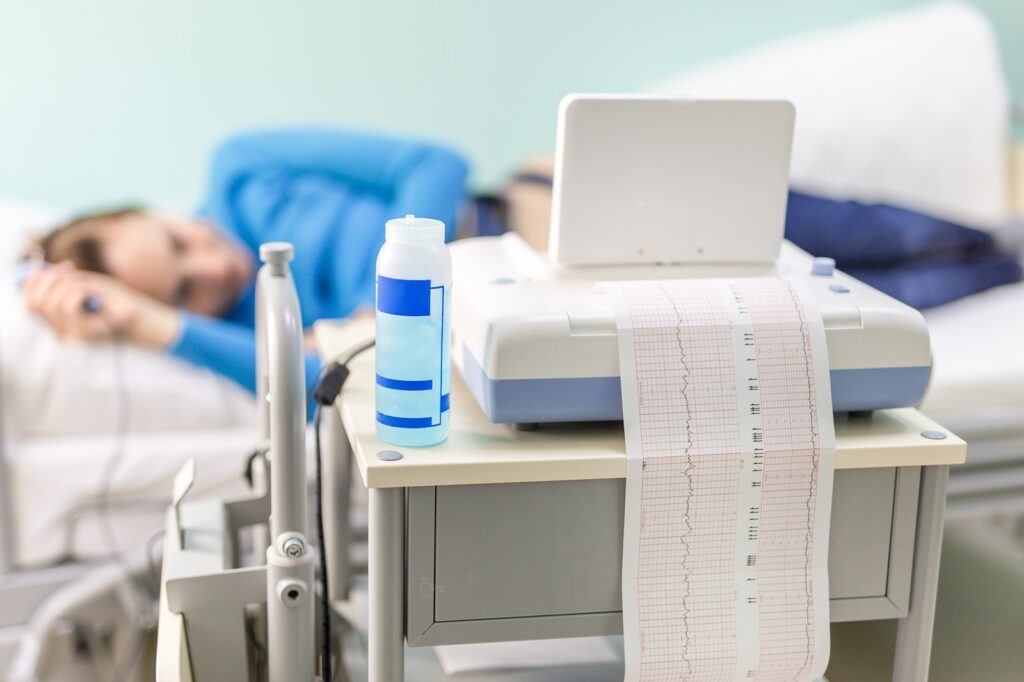

Sarah* was pregnant for the third time. Her pregnancy had gone relatively well until her waters broke at around 7 and a half months. She attended her local maternity unit and they used a CTG to monitor her baby’s heartrate. The results were reassuring, so they made a plan to induce Sarah in a couple of days.
That evening, Sarah was worried that she had not felt her baby move, and another CTG was started. This was interpreted by the machine as normal and after 52 minutes they stopped. However, a midwife listened to the baby’s heart rate manually and was concerned that there were temporary drops in the heart rate. This can indicate a baby is in distress. The midwife checked with a colleague who also felt the CTG had shown worrying signs. In spite of this, a registrar (a middle-level doctor) later decided that the CTG was ok, but another one was needed at 6am.
At 5am, Sarah was having contractions and was losing pink-coloured waters. The plan was to start another CTG but sadly they were unable to find Sarah’s daughter’s heartbeat. Her daughter was stillborn later that day.
Following her daughter’s death, Sarah understandably struggled with her mental health. For ten months she was diagnosed with Post-Traumatic Stress Disorder, and she suffered from distressing thoughts, nightmares and flashbacks. This negatively impacted Sarah’s life in many important ways, including her relationships and her job.
Investigation
Following Sarah’s daughter’s death, the hospital prepared a Serious Incident Investigation Report. This found that there were areas of Sarah’s care which were not correct, including that the CTG should not have been stopped when there were concerns. It also concluded that the registrar’s decision to simply repeat the CTG in the morning was made without knowing all the information or reviewing Sarah fully.
Contacting Enable Law
Sarah approached Enable Law to help her get answers about what happened to her daughter and whether her death could have been avoided. Following our own investigations, we sent a letter of claim to the hospital, outlining our allegations of what went wrong and that had the CTG stayed in place, it would have become more concerning. Therefore, the decision would have been made to intervene and her daughter would have been born before she died.
The hospital admitted that they caused Sarah’s daughter’s death and apologised for the poor care.
A settlement was achieved without the need to start the court process. It was hoped that this would enable Sarah to get the therapy and support that she needed, and to create a positive legacy in her daughter’s name.
Nicola Rawlinson-Weller, who represented Sarah said ‘Whilst no amount of money can change what has happened to Sarah and her family, the legal process can be a positive aid to change. Sarah’s courage in bringing a claim has enabled us to ensure that the issues with her care were carefully examined, and the hospital has hopefully learnt lessons so that the same mistakes aren’t made with any other families. This is the primary goal of Sarah and other families impacted by baby loss.’.
Our specialist baby loss team is here to help
Enable Law has a specialist baby loss team where we have helped many families who have suffered a stillbirth or neonatal death where the monitoring was insufficient or was not interpreted correctly. If you are concerned that you were monitored incorrectly during your pregnancy or labour, and your baby has suffered an injury or passed away, we can advise you. To speak to Nicola Rawlinson-Weller or another member of our team contact us on 0800 044 8488 or fill in our contact form so we can arrange to call you at a time convenient to you.
*not her real name.